
B2B lead generation is the process of identifying, attracting, and qualifying potential business customers to create sales conversations that convert to revenue. The industry term is "demand generation" when applied at scale, but lead generation specifically refers to filling your pipeline with prospects who have a real reason to buy. Done right, it's not about collecting contacts. It's about building a pipeline of qualified opportunities where budget, authority, need, and timeline are already confirmed before your sales team picks up the phone. Frameworks like BANT, channels like LinkedIn outreach, and tools like intent data platforms are the building blocks of any modern B2B lead generation system in 2026.
What is B2B lead generation, and why does it drive revenue?
B2B lead generation is the structured process of finding companies and decision-makers who match your ideal customer profile, then engaging them until they're ready for a sales conversation. The goal is not a spreadsheet full of names. The goal is a pipeline of qualified conversations.

Here's the distinction that matters: a pipeline of qualified conversations consistently outperforms bulk contact lists, regardless of volume. A company generating 50 high-intent conversations per month is better positioned than one sitting on 500 generic contacts from a purchased list. That gap in quality is where most B2B revenue is won or lost.
What makes a lead "qualified" in B2B? The BANT framework is the standard filter. BANT stands for Budget, Authority, Need, and Timeline. A prospect who checks all four boxes is a real sales opportunity. One who checks only one or two is a marketing contact, not a pipeline entry. Treating them the same is one of the most common and costly mistakes in B2B sales.
The importance of B2B leads goes beyond filling a CRM. Qualified leads shorten sales cycles, reduce wasted rep time, and directly improve revenue predictability. For sales and marketing teams under pressure to hit quarterly targets, lead quality is the lever that moves the number.
How do inbound and outbound strategies differ in B2B lead generation?
Inbound and outbound are not competing philosophies. They're complementary tools with different timelines and use cases. Understanding when to use each is one of the most practical decisions you'll make in building your lead generation system.
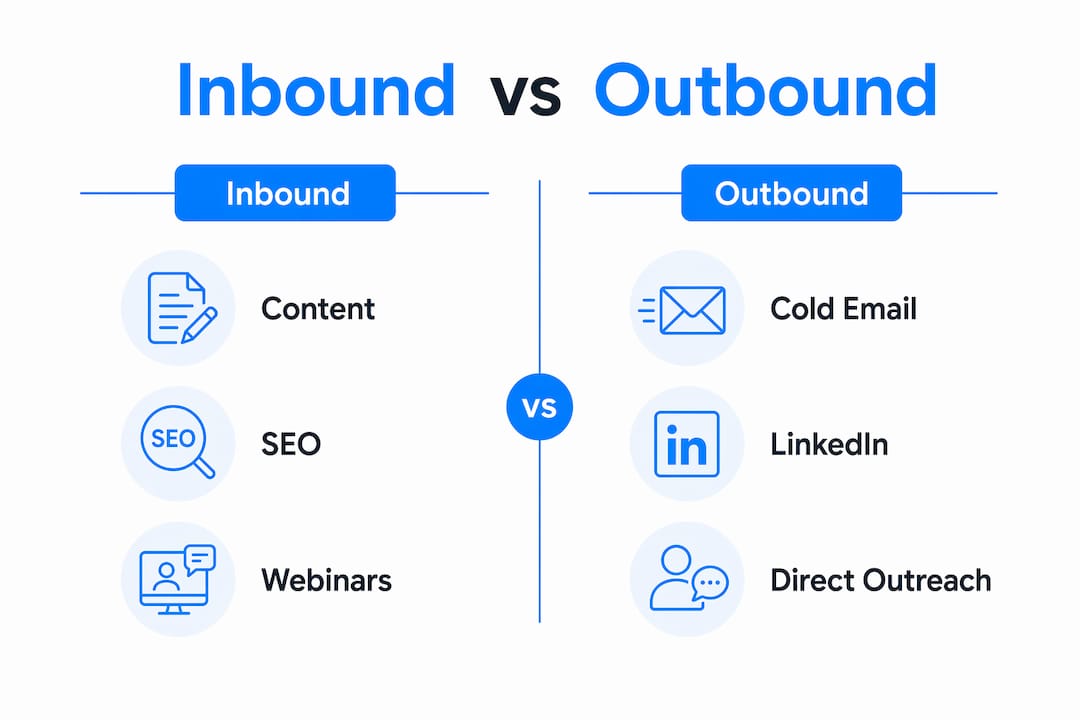
Inbound lead generation attracts prospects through content, SEO, and thought leadership. Blog posts, whitepapers, webinars, and LinkedIn content pull buyers toward you when they're already researching a problem. The compounding effect is real, but inbound strategies require 6–18 months to produce consistent traffic and leads. Inbound is a long game. It rewards patience and consistency.
Outbound lead generation puts you in front of prospects before they raise their hand. Cold email, LinkedIn outreach, and targeted paid campaigns are the primary channels. Outbound can produce pipeline results within weeks. The tradeoff is that it requires ongoing effort and precise targeting to avoid burning your sender reputation or wasting budget on the wrong audience.
Here's how to think about which to prioritize:
- Early-stage companies with limited brand presence should lean heavily on outbound. You need pipeline now, and you can't wait 12 months for SEO to compound.
- Growth-stage companies with some market recognition should run both in parallel. Outbound fills the short-term pipeline while inbound builds long-term authority.
- Mature companies with strong brand equity can rely more on inbound but should keep outbound active for new segments or product lines.
Pro Tip: Pick one outbound channel and one inbound channel to master before adding more. Spreading across five channels at once produces mediocre results on all of them.
The most effective B2B lead generation strategies are not channel-specific. They're system-specific. The channel is just the delivery mechanism. The system is what converts attention into revenue.
Why lead qualification beats lead volume every time
The volume mentality is the single biggest trap in B2B lead generation. Marketing teams celebrate MQL counts. Sales teams complain the leads don't convert. The disconnect is almost always a qualification problem.
BANT-qualified appointment generation produces 3X higher conversion rates and 60% lower cost per customer compared to chasing MQL volume. That's not a marginal improvement. It's a structural advantage that compounds over every quarter.
Here's what BANT qualification looks like in practice:
| BANT Criterion | What to confirm | Why it matters |
|---|---|---|
| Budget | Does the prospect have allocated funds? | Prevents late-stage deal collapse over price |
| Authority | Are you talking to a decision-maker? | Avoids wasted cycles with influencers only |
| Need | Does your solution solve a real, active problem? | Filters out curiosity from genuine intent |
| Timeline | Is there a defined window to buy? | Separates active deals from future pipeline |
BANT qualification shifts the focus from volume MQLs to revenue opportunities by confirming these four criteria before a sales appointment is ever scheduled. The result is a shorter sales cycle, fewer surprises late in the deal, and a pipeline that your revenue forecast can actually trust.
Pro Tip: Score leads in your CRM against BANT criteria before passing them to sales. A lead that scores 3 out of 4 is worth a conversation. A lead that scores 1 out of 4 belongs in a nurture sequence, not a sales queue.
The quality-over-quantity mindset also changes how marketing and sales teams collaborate. When both teams agree on what a qualified lead looks like, handoffs become cleaner and conversion rates improve across the board.
How has the modern B2B buying process changed lead generation?
The single-decision-maker model is obsolete. Modern B2B purchases involve 6–10 stakeholders, and complex enterprise deals can involve up to 22 people influencing the final decision. That number should change how you think about every outreach campaign you run.
Targeting only the VP of Sales or the CTO is a fragile strategy. If that one contact goes cold, changes jobs, or gets overruled internally, your deal stalls. Engaging the full buying committee gives you multiple entry points, multiple champions, and a much higher probability of moving the deal forward.
Effective stakeholder engagement in 2026 looks like this:
- Map the buying committee early. Identify the economic buyer, the technical evaluator, the end user, and the internal champion before your first outreach.
- Personalize by role, not just by company. A CFO cares about ROI and risk. An IT director cares about integration and security. Your messaging should reflect those priorities.
- Engage across departments simultaneously. Don't wait for one contact to introduce you internally. Reach out to multiple stakeholders in parallel with coordinated, non-conflicting messaging.
- Track engagement signals across the committee. If three people from the same company visit your pricing page in one week, that's a buying signal worth acting on immediately.
The practical implication for your lead generation system is that your outreach tools need to support multi-contact campaigns within a single account. Sending one email to one person and waiting is not a B2B lead generation strategy. It's a lottery ticket.
What practical steps build an effective B2B lead generation system?
Building a lead generation system that actually produces qualified pipeline requires more than picking a tool and sending messages. Here's a practical framework for getting it right.
-
Define your Ideal Customer Profile (ICP). Your ICP is the specific type of company most likely to buy, stay, and expand. Include firmographic data like industry, company size, and revenue range, plus behavioral signals like recent funding rounds or hiring patterns.
-
Select your channels based on your ICP. If your buyers are active on LinkedIn, outbound LinkedIn outreach is a high-leverage channel. If they consume long-form content, invest in SEO and thought leadership. Match the channel to where your buyers actually spend time.
-
Blend inbound, outbound, paid, and nurture. No single channel consistently outperforms a strategic mix. Inbound builds authority, outbound creates immediate pipeline, paid amplifies reach, and nurture converts the leads that aren't ready yet.
-
Use intent signals and trigger events. Web visitor identification tools, job change alerts, and funding announcements are trigger events that tell you when a prospect is in an active buying mode. Reaching out at the right moment with relevant context converts far better than cold, unsolicited outreach.
-
Build a lead scoring and handoff process. Define the criteria that move a lead from marketing to sales. Use BANT as your baseline. Automate the scoring where possible so reps spend time on the leads most likely to close.
Disciplined focus on 3–4 well-matched strategies can drive 18%–34% of total pipeline growth within six months. That's the case for focus over breadth. Chasing every channel simultaneously dilutes your effort and produces inconsistent results.
Pro Tip: Run a 90-day sprint on two channels before evaluating performance. Most teams abandon channels too early or add new ones before the current ones have matured.
Key takeaways
B2B lead generation succeeds when you prioritize qualified conversations over contact volume, engage full buying committees, and run a disciplined multi-channel system built around a clearly defined Ideal Customer Profile.
| Point | Details |
|---|---|
| Quality beats volume | 50 qualified conversations outperform 500 generic contacts in pipeline value. |
| BANT drives conversion | BANT-qualified leads produce 3X higher conversion and 60% lower cost per customer. |
| Buying committees are the norm | Modern B2B deals involve 6–10 stakeholders; target the full committee, not one contact. |
| Focus on 3–4 channels | Disciplined multi-channel focus drives 18%–34% pipeline growth within six months. |
| Inbound takes time | Inbound strategies require 6–18 months to compound; outbound fills the gap in the short term. |
What I've learned after years of watching B2B lead gen programs succeed and fail
Most lead generation programs fail for one reason: they optimize for the wrong metric. Teams celebrate MQL volume, SDRs celebrate activity counts, and leadership celebrates pipeline coverage. Nobody is celebrating qualified conversations, which is the only metric that actually predicts revenue.
I've seen companies with 2,000 MQLs per month and a pipeline that couldn't close a deal. I've also seen lean teams generating 60 qualified appointments per month and consistently hitting quota. The difference is always qualification discipline and stakeholder engagement, not channel selection or tool choice.
The other pattern I keep seeing is the marketing and sales misalignment problem. Marketing defines a lead one way. Sales defines it another. The handoff is messy, the follow-up is slow, and both teams blame each other for the miss. The fix is simple but requires real commitment: agree on a shared definition of a qualified lead before you build any campaign.
The buyers have also changed. They're doing more research independently, involving more colleagues in the decision, and expecting outreach to be relevant and timely. Generic cold outreach to a single contact with a templated pitch is not just ineffective. It actively damages your brand with the people you most want to reach. The teams winning in 2026 are the ones treating every outreach as a personalized, research-backed conversation starter, not a numbers game.
— Christian
How Deskflow helps you build a qualified B2B pipeline on LinkedIn
If you're serious about generating qualified B2B pipeline without spending hours on manual research and follow-up, Deskflow is built for exactly that.
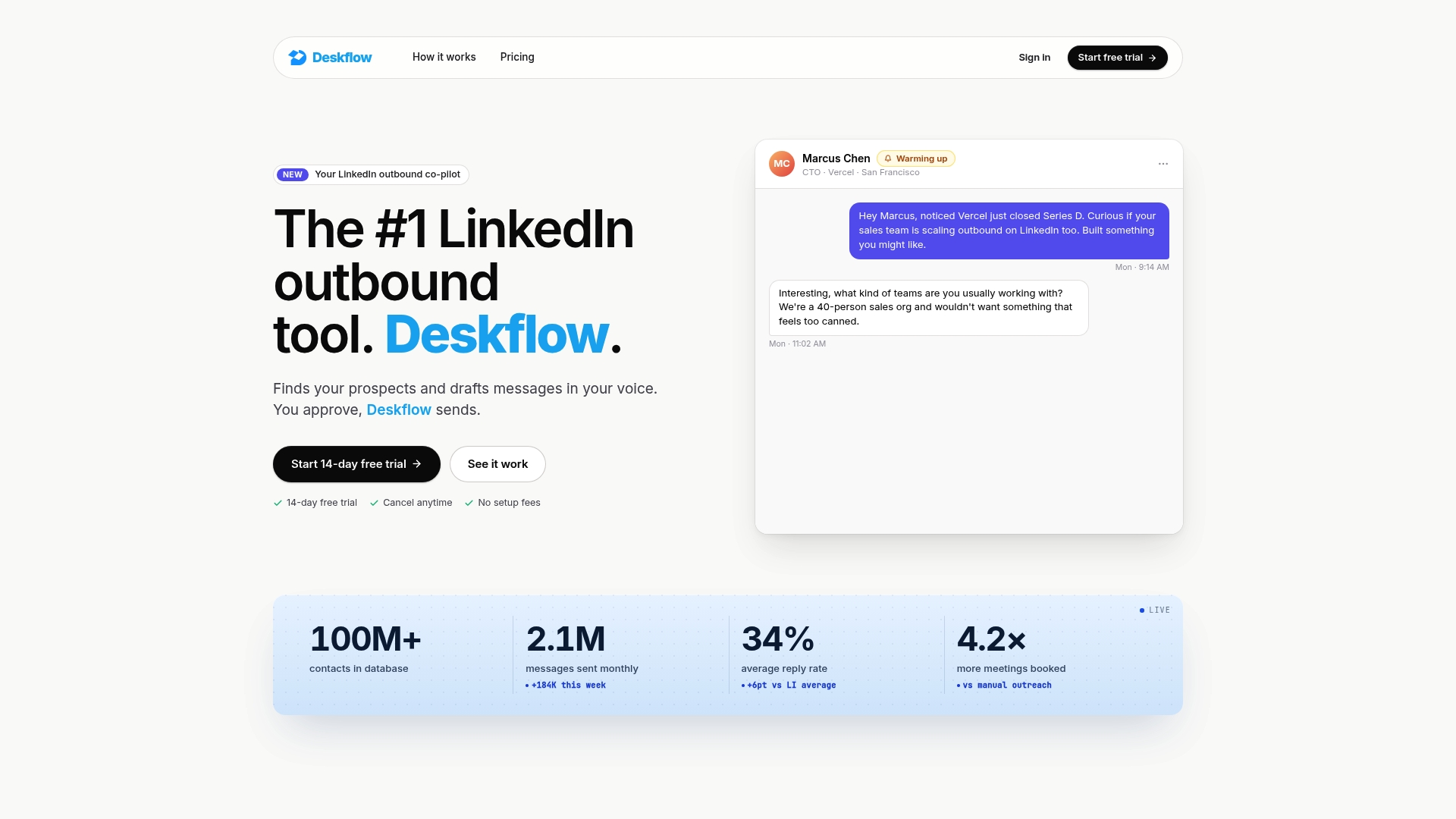
Deskflow is an AI-powered platform that automates LinkedIn prospecting and outreach for B2B sales teams. You can import LinkedIn Sales Navigator searches or build targeted lists directly in the platform. Deskflow then handles contact enrichment, personalized message generation based on each prospect's LinkedIn activity, and automated follow-up sequences. The result is more qualified conversations with less administrative work. If your team is ready to stop chasing volume and start building a pipeline that actually converts, Deskflow is worth a look.
FAQ
What are B2B leads?
B2B leads are companies or individual decision-makers who have shown interest in your product or service and fit your Ideal Customer Profile. A qualified B2B lead meets BANT criteria: confirmed budget, decision-making authority, a real need, and a defined purchase timeline.
How long does B2B lead generation take to produce results?
Outbound strategies like LinkedIn outreach and cold email can produce pipeline results within weeks. Inbound strategies like SEO and content marketing require 6–18 months to generate consistent lead flow.
What is the BANT framework in B2B lead generation?
BANT stands for Budget, Authority, Need, and Timeline. It's a qualification filter used to confirm that a prospect is a genuine sales opportunity before investing rep time in a full sales cycle.
How many stakeholders are involved in a typical B2B purchase?
Modern B2B buying decisions involve 6–10 stakeholders on average, and complex enterprise deals can involve up to 22 people. Effective lead generation targets the full buying committee, not just one contact.
What B2B lead generation tools should sales teams use?
Sales teams benefit from a combination of LinkedIn Sales Navigator for prospecting, intent data platforms for trigger event tracking, CRM tools like HubSpot or Salesforce for lead scoring, and outreach automation platforms like Deskflow for personalized multi-contact campaigns at scale.