
Sales follow-up messages are strategic communications sent across multiple channels to nurture leads, maintain momentum, and move prospects toward a decision. 80% of B2B sales close between the 5th and 12th follow-up attempt, yet 44% of reps quit after just one no-response. That gap is where deals die. The types of sales follow-up messages you send, and when you send them, determine whether a prospect converts or goes cold. Tools like Pipedrive, LinkedIn Sales Navigator, and Deskflow have made it easier to run structured, multi-channel sequences that keep you in front of the right people at the right time.
1. What are the main types of sales follow-up messages?
Sales professionals use five core categories of follow-up messages. Each serves a different purpose depending on where the prospect sits in the pipeline.
- Reminder follow-ups nudge a prospect about an unanswered proposal, a pending decision, or a scheduled meeting. They are short, direct, and reference the specific item waiting on the prospect's end.
- Value-add follow-ups deliver something new: a case study, an industry benchmark, a relevant article, or a short insight tied to the prospect's business. Generic "checking in" emails have a reply rate of approximately 1%. Value-add messages exist to fix that problem.
- Recap follow-ups summarize a meeting or demo and list the agreed next steps. Pipedrive's sales team recommends sending these within 24 hours to keep momentum alive.
- Breakup follow-ups are sent when a prospect has gone silent after multiple touches. They signal that you're closing the loop, which often prompts a reply. Breakup emails generate a 10–20% reply rate, making them one of the most underused tools in a rep's kit.
- Multi-channel follow-ups combine email, phone, LinkedIn, and video messages in a rotating sequence. Alternating channels boosts response rates by up to 287% compared to email-only outreach.
Pro Tip: Never send two follow-ups in a row on the same channel. Rotate between email, LinkedIn, and phone to avoid spam filters and stay visible without being repetitive.
2. How to craft effective follow-up messages

The structure of a follow-up message matters as much as its timing. A well-built message has four components: a context anchor, a neutral tone, one piece of fresh value, and a single clear ask.
Start with a context anchor. Reference your last interaction in the first sentence. "Following up on the proposal I sent tuesday" or "Circling back after our call last week" gives the prospect an immediate frame of reference. It removes the cognitive load of remembering who you are.
Use a blameless tone. Passive-aggressive openers like "I haven't heard back from you" signal frustration and put the prospect on the defensive. Neutral openers that assume busyness, such as "I know things get hectic," keep the relationship intact. The goal is to make it easy to reply, not to make the prospect feel guilty.
Add one piece of fresh value. Each follow-up should give the prospect a reason to engage beyond the original pitch. A relevant stat, a short customer story, or a new angle on their specific challenge all qualify. This is what separates a professional sequence from inbox noise.
End with a single, binary ask. Single-ask messages with a yes/no or time-boxed question outperform open-ended requests. "Does Thursday at 2 PM work for a 15-minute call?" beats "Let me know if you'd like to connect sometime."
Pro Tip: Keep follow-up emails between 50 and 125 words. That range consistently produces the highest response rates. LinkedIn messages and texts should be even shorter, ideally under 75 words.
For deeper guidance on email personalization tactics that apply directly to follow-up sequences, Deskflow's blog covers the current best practices in detail.
3. Best timing and sequencing for follow-up messages
Timing is not a soft variable. It is a measurable factor that directly affects whether your message gets read or ignored.
When to send your first follow-up
Send the first follow-up 3–5 business days after initial contact. This gives the prospect time to process your first message without letting the conversation go cold. After a meeting or demo, the recap follow-up is the exception: send it within 24 hours.
How to structure a full sequence
A standard B2B sequence runs 4–6 touches spaced 4–7 days apart, covering a total window of 14–30 days depending on deal complexity. Here is a practical structure:
- Day 1: Initial outreach via email
- Day 4: Value-add follow-up via email
- Day 8: LinkedIn connection or message
- Day 13: Phone call attempt
- Day 19: Email with a new insight or case study
- Day 26: Breakup message via email
Response rates by channel
| Channel | Typical response rate | Best use case |
|---|---|---|
| 5–15% | Initial outreach, value-adds, recaps | |
| Phone | 15–25% | Mid-sequence warm-up, closing stage |
| 10–20% | Cold outreach, connection building | |
| Video message | Varies | High-value prospects, late-stage deals |
Phone calls carry the highest individual response rate at 15–25%, which is why they belong in the middle of a sequence rather than at the end. Saving your strongest channel for the final touch wastes its impact.
For a full breakdown of how to structure your outbound sales workflow, Deskflow's guide covers the step-by-step process.
4. Comparing follow-up message types by sales scenario
Not every message type fits every situation. Cold leads, warm prospects, and deals at the closing stage each call for a different approach.
| Message type | Best for | Timing | Channel | Key strength |
|---|---|---|---|---|
| Reminder | Warm prospects, pending proposals | 3–5 days after send | Email or phone | Keeps deals from stalling |
| Value-add | Cold leads, early nurture | Every 5–7 days | Email or LinkedIn | Builds credibility over time |
| Recap | Post-meeting or post-demo | Within 24 hours | Locks in next steps | |
| Breakup | Unresponsive prospects | Final touch, day 25–30 | Pattern interrupt, prompts reply | |
| Multi-channel | All stages | Rotating throughout sequence | Email, phone, LinkedIn | Maximizes reach and deliverability |
Cold leads respond best to short LinkedIn connection messages and brief introductory emails. Asking for a 30-minute call on the first touch is too much friction. A simple connection request with a one-line observation about their business works better.
Warm prospects, meaning those who have engaged with your content or replied at least once, respond well to value-add emails and phone attempts. They already know who you are. Your job is to give them a reason to move forward.
At the closing stage, directness wins. A clear ask, a deadline, or a breakup message forces a decision. Ambiguity at this stage costs deals. Adapting your message type to the number of decision-makers involved also matters. Complex deals with multiple stakeholders need longer sequences and more social proof in each touch.
Key takeaways
The most effective sales follow-up strategy combines message type, channel rotation, and timing into a structured sequence that delivers fresh value at every touch.
| Point | Details |
|---|---|
| Multi-channel sequences win | Rotating email, phone, and LinkedIn boosts response rates by up to 287% vs. email alone. |
| Value beats check-ins | Generic "checking in" messages average a 1% reply rate. Add a new insight to every follow-up. |
| Timing is fixed, not flexible | Start follow-ups 3–5 days after initial contact and space touches 4–7 days apart. |
| One ask per message | Binary or time-boxed asks outperform open-ended requests every time. |
| Breakup messages work | A well-crafted breakup email generates a 10–20% reply rate and closes the loop professionally. |
Why most reps are thinking about follow-ups the wrong way
Sales professionals tend to treat follow-ups as a persistence game. Send enough messages and eventually someone replies. That framing is wrong, and it shows in the results.
The reps I've seen close the most deals treat each follow-up as a standalone communication. It has to earn the prospect's attention on its own merits. That means every message needs a reason to exist beyond "I still want your business." A new customer story, a stat that reframes the problem, a question tied to something the prospect mentioned in a previous call. These details are what separate a sequence that converts from one that gets marked as spam.
The other mistake I see constantly is the multi-ask follow-up. Reps pack three questions into one email and wonder why no one replies. Prospects don't prioritize your email. They scan it, feel the weight of multiple asks, and move on. One question, one action, one clear next step. That's the formula.
Video messages are still underused in 2026. A 60-second personalized video sent via LinkedIn or embedded in an email stands out in a way that text simply cannot. I've watched reps use video at the third or fourth touch and revive conversations that had been dead for two weeks. It's not a gimmick. It's a channel that most of your competitors haven't adopted yet.
The last thing worth saying: build in a pause. After 6 touches with no response, stop. Wait 30 days and try again with a fresh angle. Prospect burnout is real, and hammering the same person every week does lasting damage to your brand.
— Christian
How Deskflow fits into your follow-up strategy
Running a multi-channel follow-up sequence manually is time-consuming. Tracking who got which message, on which channel, on which day adds up fast across a full pipeline.
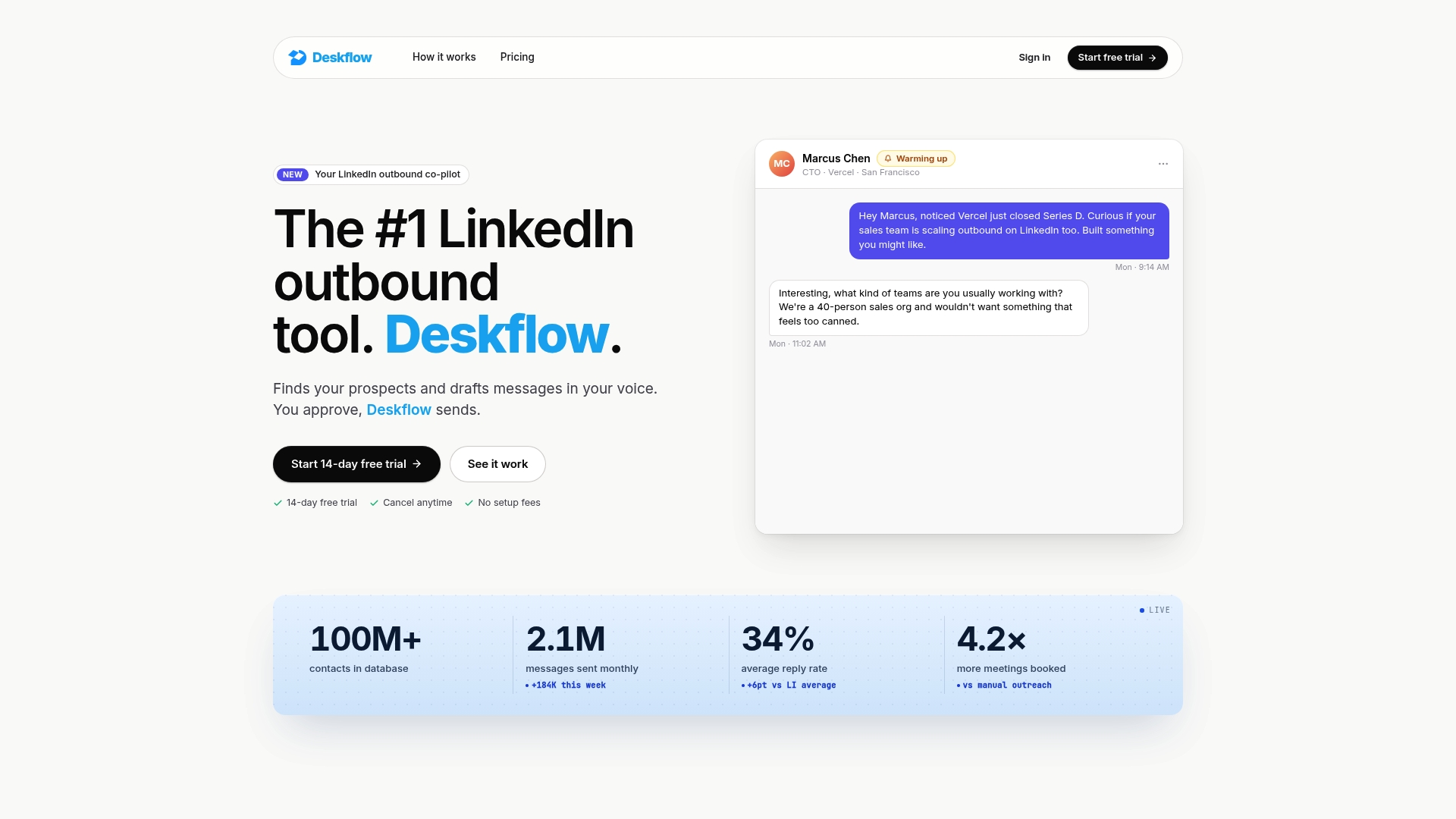
Deskflow automates LinkedIn outreach and follow-up sequences so your team can focus on the conversations that matter. The platform generates personalized messages based on a prospect's LinkedIn profile and activity, manages channel rotation, and handles timing automatically. You build the sequence once, and Deskflow runs it. Sales reps spend less time on admin and more time on qualified conversations. If you're running outbound at any real volume, that's a meaningful shift in how your team operates.
FAQ
How many follow-up messages should I send before giving up?
Send 4–6 follow-up touches over a 14–30 day window before sending a breakup message. 80% of B2B sales close between the 5th and 12th attempt, so persistence within a structured sequence is the standard.
What is the best channel for sales follow-up messages?
Phone calls produce the highest individual response rate at 15–25%, but the best results come from rotating channels across email, phone, and LinkedIn throughout your sequence.
How long should a follow-up email be?
Keep follow-up emails between 50 and 125 words. Emails in that range consistently produce the highest response rates across B2B outreach.
What is a breakup email in sales?
A breakup email is a final follow-up that signals you're closing the conversation. It gives the prospect an easy way to opt out, which often prompts a reply. Breakup messages generate a 10–20% reply rate and preserve the relationship for future outreach.
When should I send a post-meeting follow-up?
Send a recap follow-up within 24 hours of any meeting or demo. Include a summary of what was discussed and clear next steps to keep the deal moving forward.