
A sales activity metric is a quantifiable measure of the specific actions sales representatives perform throughout the sales process, such as calls made, emails sent, meetings booked, and proposals delivered. These metrics track effort and input, not outcomes. They sit at the foundation of any serious sales performance analysis, and they give sales leaders a clear view of what their teams are actually doing each day. CRM platforms like Salesforce, Pipedrive, and Oracle all treat activity metrics as core reporting objects, and for good reason: activity metrics are leading indicators that predict pipeline health before a single deal closes.
What is a sales activity metric and why does it matter?
A sales activity metric measures a discrete, repeatable action a sales rep takes to move a prospect through the pipeline. Common examples include calls made, emails sent, meetings booked, follow-ups completed, proposals sent, and social media touches. Each of these is logged in a CRM as a task, event, or activity object, and then aggregated for reporting.
The reason these metrics matter is simple. You cannot manage what you cannot see. If a rep closes no deals in a given month, a manager looking only at revenue data has no idea whether the problem is low activity, poor conversion, or bad targeting. Activity metrics expose the effort layer, and that exposure is what makes coaching possible.
Sales activity metrics also power forecasting models. Calls-to-meetings ratios, meetings-to-demos ratios, and demos-to-close ratios let you work backward from a revenue target to calculate exactly how many calls your team needs to make. That kind of math is impossible without reliable activity data.
What types of sales activity metrics are most commonly tracked?
Sales teams track two broad categories of activity metrics: volume metrics and efficiency metrics. Volume metrics count raw actions. Efficiency metrics measure how well those actions convert.
The most common volume metrics include:
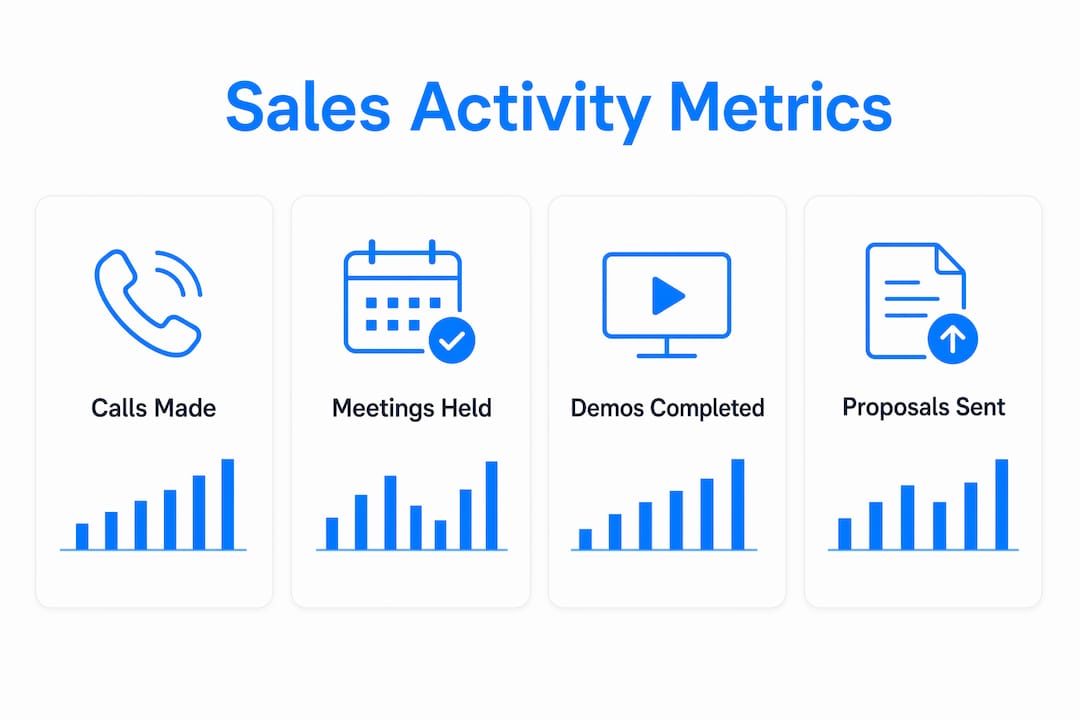
- Calls made: Total outbound dials per rep per day or week
- Emails sent: Outreach volume across cold and warm sequences
- Meetings booked: Prospects who accepted a calendar invite
- Demos completed: Discovery or product demos actually held
- Proposals sent: Formal quotes or scopes delivered to prospects
- LinkedIn touches: Connection requests, InMail messages, and profile views used as outreach
Each metric tells a different part of the story. Calls made shows top-of-funnel effort. Demos completed shows mid-funnel momentum. Proposals sent signals late-stage activity. Together, they map the full shape of a rep's week.
Efficiency metrics add the quality layer. Outreach-to-meeting conversion rate tells you how effective a rep's messaging is. Demo-to-proposal conversion rate reveals whether discovery calls are qualifying prospects properly. B2B SaaS teams often weight demos and proposals heavily, while enterprise sales teams may prioritize relationship-building meetings and executive touchpoints over raw call volume.

Pro Tip: Track both meetings booked and meetings held as separate metrics. A rep who books 20 meetings but only holds 12 has a no-show problem, not a prospecting problem. The distinction changes how you coach.
How do sales activity metrics differ from sales performance metrics?
Sales activity metrics and sales performance metrics measure different things. Confusing them leads to bad coaching decisions.
Activity metrics measure efficiency of effort, the inputs a rep controls. Performance metrics measure outcomes, the results those inputs produce. Both are necessary, and neither is sufficient on its own.
| Metric type | What it measures | Example | Indicator type |
|---|---|---|---|
| Sales activity metric | Effort and input | Calls made, emails sent | Leading |
| Sales performance metric | Outcome and result | Revenue closed, win rate | Lagging |
| Conversion metric | Efficiency between stages | Outreach-to-meeting rate | Leading/Lagging |
Leading indicators like activity metrics predict future results and allow proactive management. Lagging indicators like revenue and win rate confirm what already happened. A manager who waits for lagging indicators to spot a problem is always reacting. A manager who watches activity metrics can intervene weeks earlier.
"Sales activity metrics provide foundational insights into what the sales team spends time doing, but sales leaders must interpret them as efficiency inputs rather than direct success outcomes." — Pipedrive
The practical implication is this: use activity metrics to guide weekly coaching conversations, and use performance metrics to evaluate quarterly results. They answer different questions, and they belong in different conversations.
What are the most common pitfalls in measuring sales activity metrics?
Measuring activity metrics poorly is worse than not measuring them at all. Bad data produces confident, wrong decisions.
The four most common pitfalls are:
-
Vanity metrics from raw volume counts. Tracking activity volume alone creates vanity metrics that show motion without progress. A rep who sends 200 emails a week but books zero meetings is busy, not effective. Volume without conversion context is noise.
-
Inconsistent activity definitions. Logging discrepancies occur when reps log activities as placeholders rather than actual executions. "Meeting booked" and "meeting held" must be defined and tracked separately. If your CRM conflates them, your data is wrong before you even run a report.
-
Unfiltered aggregation in large CRMs. Oracle CRM documentation warns that large activity fact tables require careful filtering by activity type, user, time period, and campaign to avoid double counting. A single unfiltered query can produce totals that look impressive and mean nothing.
-
Isolating activity metrics from outcome data. Activity metrics used alone, without pairing them to conversion or pipeline data, give you half a picture. A rep with high call volume and low pipeline contribution has a quality problem, not a quantity problem.
Pro Tip: Run a monthly audit of your CRM activity logs. Pull a sample of 20 logged "meetings held" and verify them against calendar records. If more than 10% are placeholders or errors, your data hygiene needs attention before your coaching does.
The fix for all four pitfalls is the same: standardize definitions, enforce data entry rules, and always pair volume counts with at least one conversion or quality metric. Implementation success depends on standardizing activity definitions and enforcing strict data entry rules so metrics reflect real execution.
How to implement sales activity metrics that actually improve performance
Selecting the right metrics starts with your sales model. A high-velocity inside sales team needs different activity benchmarks than an enterprise team running six-month deal cycles. Start by mapping your sales process stages, then identify one or two activity metrics per stage.
Here is a practical framework for implementation:
- Stage 1 (Prospecting): Track calls made, emails sent, and LinkedIn touches per rep per week. Set benchmarks based on your top performers, not industry averages.
- Stage 2 (Qualification): Track meetings booked and meetings held. Calculate your meeting-held rate to catch no-show patterns early.
- Stage 3 (Evaluation): Track demos completed and proposals sent. Monitor demo-to-proposal conversion to assess discovery quality.
- Stage 4 (Closing): Track follow-ups sent and time-to-close by rep. Slow follow-up after a proposal is a common and fixable revenue leak.
Once you have the metrics defined, your CRM does the heavy lifting. Salesforce, Pipedrive, and Oracle all support multi-dimensional activity reporting filtered by rep, time period, and opportunity. Build dashboards that show both volume and conversion side by side so managers see the full picture in one view.
Coaching becomes far more specific when you have this data. Instead of telling a rep to "work harder," you can say: "Your call volume is on target, but your outreach-to-meeting rate is half the team average. Let's review your opening lines." That conversation is only possible with clean activity data. You can also read more about building outbound workflows that connect activity counts to downstream conversion data.
Review your metric set every quarter. Sales processes change, and a metric that was meaningful in january may be irrelevant by March if your team shifts from cold calling to LinkedIn outreach. Outdated metrics create false confidence and misaligned coaching.
| Activity metric | What it tells you | Pair it with |
|---|---|---|
| Calls made | Top-of-funnel effort | Call-to-meeting conversion rate |
| Emails sent | Outreach volume | Reply rate, meeting booked rate |
| Meetings held | Mid-funnel engagement | Demo conversion rate |
| Proposals sent | Late-stage activity | Win rate, time-to-close |
| LinkedIn touches | Social outreach effort | Connection acceptance rate |
For teams running LinkedIn outreach, tools like Deskflow track every touch automatically, so your activity data stays accurate without relying on manual CRM logging. That matters because obsessing over raw activity counts without quality measures misguides sales efforts. Automation removes the logging burden and improves data quality at the same time. You can also explore outbound sales ROI to understand how activity data connects to revenue outcomes.
Key Takeaways
Sales activity metrics are leading indicators that measure sales rep effort, and they only deliver value when paired with conversion and quality data.
| Point | Details |
|---|---|
| Activity metrics measure inputs | Track calls, emails, meetings, and proposals to see what reps are actually doing. |
| Leading vs. lagging distinction | Activity metrics predict future results; performance metrics confirm past outcomes. |
| Volume alone misleads | Pair every volume metric with a conversion rate to separate effort from effectiveness. |
| Data hygiene is non-negotiable | Standardize activity definitions and audit CRM logs regularly to keep data accurate. |
| Coaching requires both layers | Use activity data for weekly coaching and performance data for quarterly reviews. |
Why I think most teams are measuring activity metrics wrong
Sales leaders talk about activity metrics constantly, but most teams I've seen are measuring them in a way that creates more confusion than clarity. The problem isn't the metrics themselves. The problem is that activity data gets used as a proxy for performance, and those are two completely different things.
I've watched managers celebrate a team that hit 500 calls in a week while the pipeline sat empty. The calls were real. The conversations weren't. Reps had learned to dial fast and hang up faster, and the CRM showed green across the board. That's what happens when you reward volume without checking conversion.
The other mistake I see constantly is treating all activity metrics as equal regardless of the sales stage. A LinkedIn touch in the prospecting phase and a follow-up call after a proposal are both "activities," but they carry completely different weight. Lumping them together in a single activity count is like counting warm-up laps and race laps as the same thing.
The teams that get this right do one thing differently: they build their activity dashboards around questions, not counts. Not "how many calls did we make?" but "how many calls turned into qualified conversations?" That shift in framing changes everything about how managers coach and how reps prioritize their time.
— Christian
How Deskflow fits into your sales activity tracking
Tracking LinkedIn outreach manually is one of the fastest ways to corrupt your activity data. Reps forget to log touches, misclassify connection requests as meetings, and the numbers drift from reality within days.
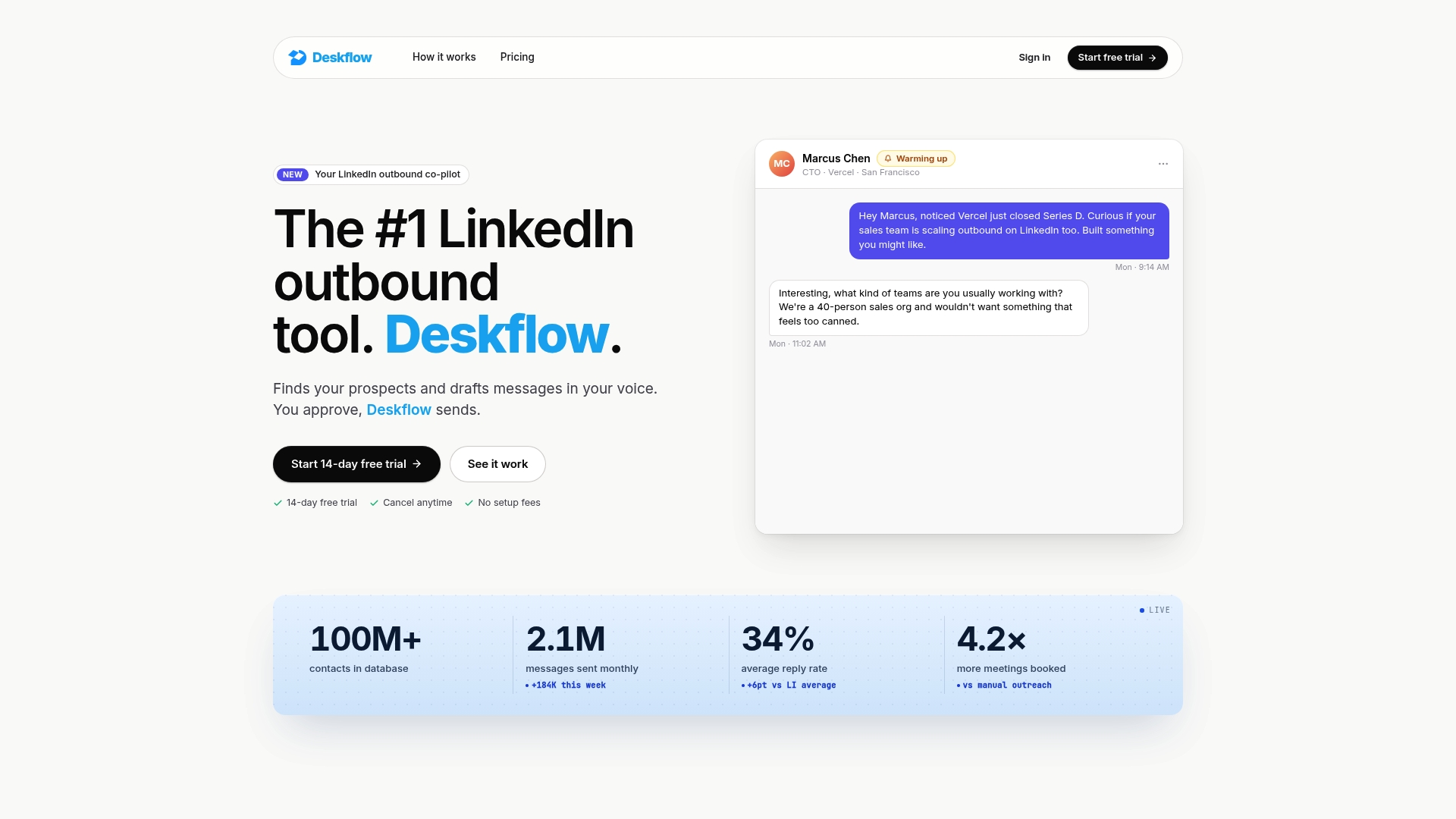
Deskflow automates LinkedIn prospecting and outreach, and every touch it generates is logged automatically. That means your calls, messages, and follow-up sequences show up in your activity data without anyone having to remember to update the CRM. You get accurate volume counts, real conversion visibility, and more time for your team to focus on actual conversations. If you're building or refining your sales email personalization strategy alongside LinkedIn outreach, Deskflow handles both in one place.
FAQ
What is a sales activity metric in simple terms?
A sales activity metric is a count or rate of a specific action a sales rep takes, such as calls made, emails sent, or meetings booked. It measures effort and input, not revenue or outcomes.
How do sales activity metrics differ from sales performance metrics?
Sales activity metrics track what reps do (inputs), while sales performance metrics track results like revenue closed and win rate (outputs). Activity metrics are leading indicators; performance metrics are lagging indicators.
What are the most important sales activity metrics to track?
The most important metrics depend on your sales model, but calls made, meetings held, demos completed, and proposals sent cover the full pipeline. Always pair each volume metric with its corresponding conversion rate.
Why do sales activity metrics sometimes give misleading results?
Misleading results come from inconsistent activity definitions, unfiltered CRM data, and tracking volume without conversion context. Standardizing definitions and auditing logs regularly keeps the data reliable.
How often should you review your sales activity metrics?
Review activity benchmarks quarterly. Sales processes shift, and metrics that reflected your team's workflow in one quarter may no longer apply after a channel or strategy change.