
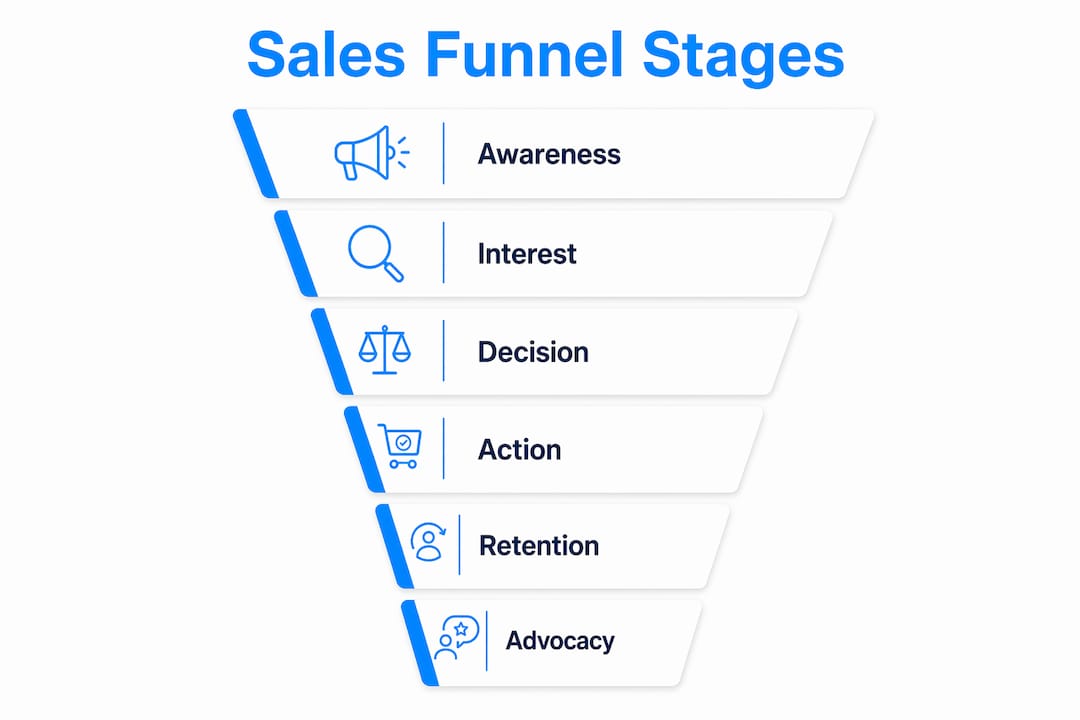
A sales funnel is defined as a visual roadmap of the customer journey from first awareness to final purchase, showing exactly where prospects are and what it takes to move them forward. The term is widely used, but the underlying model, sometimes called a purchase funnel or conversion funnel, is what sales teams at companies like IBM and Salesforce actually build their pipeline processes around. Most basic sales funnels follow four core stages: Awareness, Interest, Decision, and Action. Understanding those stages is the difference between a sales process that converts and one that leaks revenue at every turn.
What is a sales funnel and how does it work?
A sales funnel is a structured model that tracks how prospects move from first contact to closed deal. The funnel shape is intentional. You start with a wide pool of potential buyers at the top, and the number narrows at each stage as unqualified prospects drop out. That narrowing is not a failure. It is the funnel doing its job.
The funnel filters out unqualified prospects so your sales resources concentrate on the buyers most likely to close. Chasing every lead equally is one of the fastest ways to burn out your team and miss quota. A well-built funnel forces prioritization by design.

Sales funnels also serve as a diagnostic tool. When you can see exactly where prospects stop engaging, you know precisely where to fix your messaging, your offer, or your qualification criteria. Without that visibility, you are guessing.
What are the key stages of a sales funnel?
Each stage of the funnel represents a different prospect mindset, and your sales actions need to match that mindset.
| Stage | Prospect status | Sales objective |
|---|---|---|
| Awareness | Discovers your brand or product | Generate visibility through content, ads, or outreach |
| Interest | Actively researching solutions | Educate with case studies, demos, and value-focused messaging |
| Decision | Comparing options and vendors | Address objections, share proof, offer trials or proposals |
| Action | Ready to buy | Close the deal with clear next steps and contract support |
| Retention | Post-purchase customer | Deliver value, gather feedback, and build loyalty |
| Advocacy | Loyal, satisfied customer | Encourage referrals and testimonials |
At the Awareness stage, prospects do not know you well enough to trust you. Your job is to get on their radar with relevant content, targeted outreach, or paid campaigns. At the Interest stage, they are actively comparing options, so your messaging needs to speak directly to their specific problem.
The Decision stage is where most deals are won or lost. Prospects are weighing you against competitors, and every unanswered objection is a reason to walk away. At the Action stage, friction kills deals. Make it easy to sign, pay, and get started.
Modern sales funnels include Retention and Advocacy stages because repeat business and referrals cost far less to generate than new leads. Ignoring post-purchase stages leaves significant revenue on the table.
Pro Tip: Send 1–2 nurture emails per week at the Interest and Decision stages. Consistent nurturing keeps you top of mind without overwhelming prospects, and it gives them time to process your value proposition on their own terms.
How does a sales funnel differ from a marketing funnel?
Sales professionals often confuse the two, and the confusion costs them. A marketing funnel focuses on brand awareness and lead generation. A sales funnel focuses on lead qualification and conversion. Both are necessary, but they serve different goals and require different tactics.
| Dimension | Marketing funnel | Sales funnel |
|---|---|---|
| Primary goal | Generate awareness and leads | Qualify and convert leads to revenue |
| Key activities | Content, SEO, paid ads, social | Outreach, demos, proposals, closing |
| Success metric | Traffic, MQLs, brand reach | SQLs, pipeline value, win rate |
| Ownership | Marketing team | Sales team |
The two funnels hand off at the lead qualification stage. Marketing generates interest and passes leads to sales. Sales then qualifies those leads and moves them toward a decision. When that handoff is unclear, leads fall through the cracks and neither team knows who is responsible.
The practical implication for you as a sales professional: own everything from the first qualifying conversation forward. Use marketing content as a tool during nurturing, but do not wait for marketing to warm up every prospect. Outbound prospecting puts you in control of your own pipeline.
Pro Tip: Collaborate with your marketing team to define what a sales-qualified lead (SQL) looks like before it reaches you. A shared definition of lead qualification criteria prevents wasted calls and misaligned expectations on both sides.
How do you build a high-converting sales funnel?
Building a funnel that actually converts requires a repeatable process, not a one-time setup. Here are the core steps:
- Map your existing touchpoints. List every place a prospect interacts with you, from a LinkedIn message to a product demo. Gaps in that map are gaps in your funnel.
- Build buyer personas. Define your ideal customer profile (ICP) based on real data, not assumptions. Look at your best closed deals and identify the patterns: industry, company size, job title, pain points.
- Capture interest across channels. Use email, LinkedIn, phone, and content to reach prospects where they are. A single-channel approach limits your reach and increases risk.
- Nurture leads with a structured sequence. A well-planned sales sequence moves prospects through the funnel with consistent, relevant touchpoints rather than random follow-ups.
- Qualify continuously. Do not treat qualification as a one-time checkbox. Revisit fit at every stage as you learn more about the prospect's budget, timeline, and decision process.
- Close with clear next steps. Every sales conversation should end with a defined next action. Ambiguity at the close stage kills deals.
- Track and analyze funnel metrics. Measure conversion rates between stages. Funnel data as a diagnostic tells you exactly where to focus improvement efforts.
Lead scoring is one of the most underused tools in funnel management. Assign points to prospect behaviors, such as opening emails, attending demos, or visiting your pricing page, and prioritize outreach based on score. This approach outperforms gut instinct every time.
Capturing zero-party data inside your nurture sequences also pays off. When prospects click on specific use cases or respond to objection-handling content, that zero-party data feeds your CRM with context that makes every follow-up more relevant. You stop sending generic messages and start having real conversations.
Pro Tip: Weave BANT qualification questions into your conversations naturally. Asking "What does your current solution look like?" gets you qualification data without making the prospect feel like they are filling out a form.
What pitfalls should you avoid with sales funnels?
Even experienced sales professionals make the same mistakes with funnels. Knowing them in advance saves you time and pipeline.
- Expecting zero drop-off. The leaky funnel fallacy leads to false expectations. Every funnel loses prospects at every stage. The goal is to identify where the biggest drops happen and fix those specific points, not to achieve perfect capture.
- Treating qualification as a rigid checklist. BANT is a framework, not a script. Running through it mechanically creates friction and makes prospects feel interrogated rather than understood.
- Overloading prospects with low-value touches. Sending daily emails or calling every two days signals desperation. It also trains prospects to ignore you.
- Ignoring post-purchase stages. Closing a deal is not the end of the funnel. Customers who feel neglected after purchase do not renew, do not refer, and sometimes become vocal critics.
- Building a funnel once and never revisiting it. Markets shift, buyer behavior changes, and your ICP evolves. A funnel that worked last year may not work today.
Top sales teams use funnel data as a living diagnostic, adjusting messaging and process at the exact stage where prospects drop off. That discipline separates teams that hit quota consistently from those that scramble every quarter.
Key Takeaways
A sales funnel works because it forces prioritization, reveals exactly where prospects drop off, and gives sales teams a repeatable process to convert the right buyers.
| Point | Details |
|---|---|
| Funnel definition | A sales funnel maps the customer journey from awareness to purchase across defined stages. |
| Stage-specific actions | Match your messaging and tactics to the prospect's mindset at each funnel stage. |
| Sales vs. marketing funnel | Marketing generates leads; sales qualifies and converts them. Define the handoff clearly. |
| Qualification over volume | Focus on right-fit prospects using lead scoring and buyer personas, not raw lead count. |
| Continuous optimization | Use stage-by-stage conversion data to identify and fix drop-off points regularly. |
The funnel insight most sales pros miss
After working with sales teams across industries, the pattern I see most often is this: reps build a funnel, fill it with leads, and then measure success by how full the top of the funnel looks. That is the wrong metric entirely.
The real value of a sales funnel is not at the top. It is in the middle, where qualified prospects either move forward or quietly disappear. Most teams do not know their stage-by-stage conversion rates, and so they cannot tell whether their problem is lead generation, nurturing, or closing. They just know they are missing quota.
The mindset shift that changes everything is treating the funnel as a diagnostic, not a scoreboard. When I see a drop-off between Interest and Decision, that tells me the nurture content is not addressing the right objections. When I see a drop-off between Decision and Action, that tells me the close process has friction. The data points directly at the fix.
The other thing I have learned: automation and human touch are not opposites. The best funnels use automation to handle repetitive touchpoints and free up reps for the conversations that actually require judgment. Trying to do everything manually at scale leads to inconsistent follow-up, and inconsistent follow-up is the number one reason deals go cold. Build your outbound sales workflow around that principle, and your funnel will perform better almost immediately.
— Christian
How Deskflow helps you fill your funnel faster
Building a sales funnel is one thing. Filling it with qualified prospects consistently is another challenge entirely.
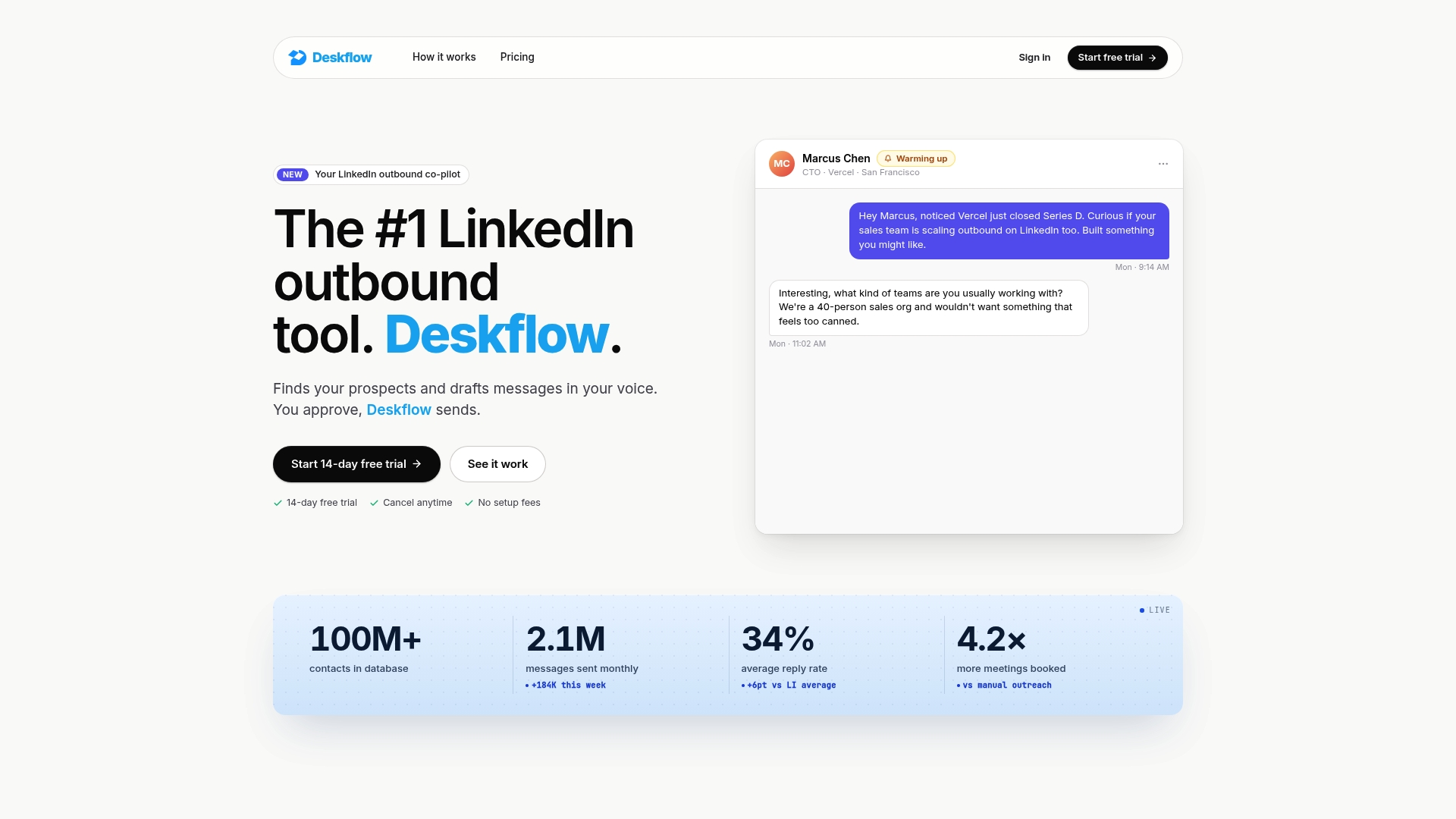
Deskflow is an AI-powered platform built specifically for LinkedIn prospecting and outreach. You can import LinkedIn Sales Navigator searches or build targeted lists directly inside Deskflow, and the platform handles contact enrichment, personalized message generation, and automated follow-up sequences. Every touchpoint is based on real prospect data, so your outreach fits the funnel stage you are targeting. If you want to spend less time on research and more time in actual sales conversations, Deskflow is built for exactly that workflow.
FAQ
What is the sales funnel definition in simple terms?
A sales funnel is a step-by-step model that tracks how prospects move from first awareness of your product to a completed purchase. It helps sales teams prioritize effort and identify where prospects drop off.
What are the main sales funnel stages?
The core stages are Awareness, Interest, Decision, and Action. Advanced funnels also include Retention and Advocacy to capture repeat business and referrals.
How is a sales funnel different from a pipeline?
A sales funnel tracks the buyer's journey and mindset at each stage. A sales pipeline tracks the specific deals a rep is actively working and their expected close dates.
What are sales funnels used for in practice?
Sales funnels are used to organize outreach, qualify leads, prioritize follow-up, and diagnose where deals are being lost so teams can fix the right problems.
How do you create a sales funnel from scratch?
Start by mapping your current touchpoints, defining your ICP, and building a nurture sequence for each funnel stage. Then track conversion rates between stages and adjust based on where prospects drop off.