
Outbound lead generation is the proactive process of identifying potential customers and initiating direct contact with them before they've expressed any interest in your product. Unlike inbound methods that wait for prospects to find you, outbound puts your sales team in control of timing, targeting, and pipeline volume. Sales development representatives (SDRs) and business development reps use tools like LinkedIn Sales Navigator, CRM platforms, and cold email sequences to reach decision-makers at scale. Done right, outbound is the fastest way to build a predictable revenue pipeline from scratch.
What is outbound lead generation and how does it work?
Outbound lead generation is a systematic sales process where your team proactively reaches out to cold leads. A cold lead is a prospect who fits your ideal customer profile but has had zero prior interaction with your brand. The goal is to move that person from unaware to interested through targeted, personalized outreach.
The process follows a clear sequence. Your team defines who to target, sources contact data, crafts a message, sends it across one or more channels, and follows up until the prospect responds or disqualifies. Channels include cold email, LinkedIn direct messages, phone calls, and paid social ads. Each touchpoint is tracked in a CRM so nothing falls through the cracks.

What makes outbound distinct is control. You choose who to contact, when to contact them, and what message they receive. That control is what makes outbound the go-to method when a company needs to generate revenue on a defined timeline, not just wait for inbound traffic to convert.
How does outbound lead generation differ from inbound?
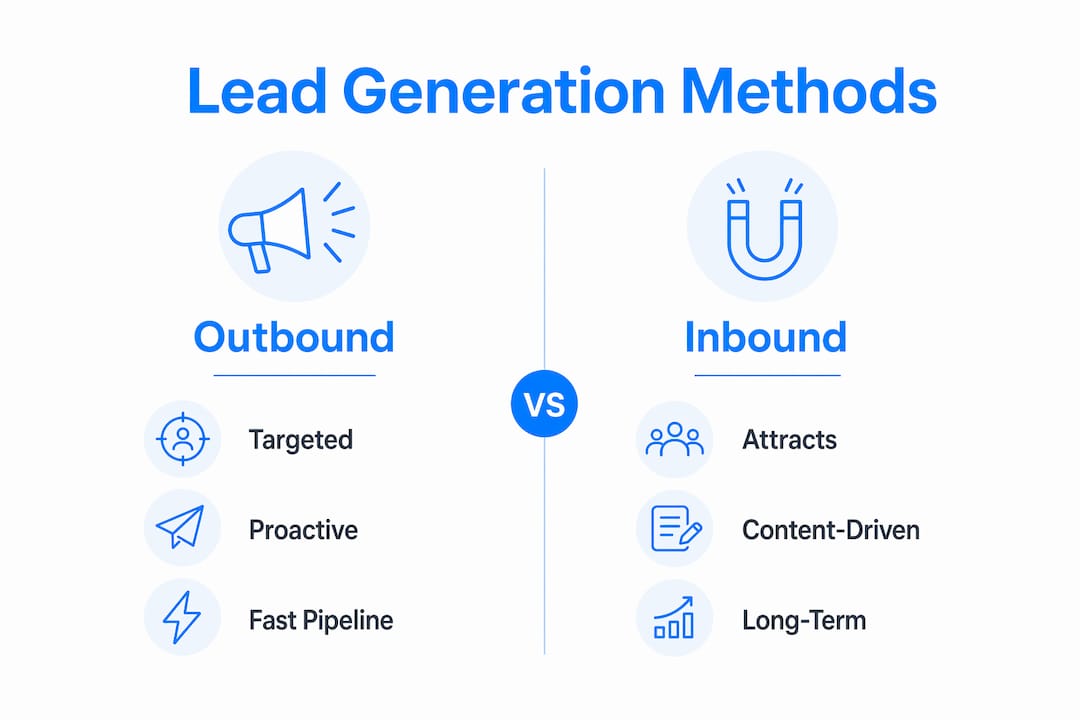
Outbound and inbound lead generation are not competing strategies. They solve different problems on different timelines. Understanding the difference helps you decide where to invest first.
Inbound attracts prospects through content, SEO, and social media. A blog post ranks on Google, a prospect finds it, and they fill out a form. The process is passive and takes months to build momentum. Outbound flips that model. You identify the right prospect and reach out directly, compressing the timeline from months to days.
Outbound and inbound work best together. Inbound builds long-term trust and brand authority. Outbound drives controllable, near-term revenue. Running both in parallel gives your pipeline two engines instead of one.
| Factor | Outbound | Inbound |
|---|---|---|
| Who initiates contact | Your sales team | The prospect |
| Speed to first lead | Days to weeks | Months |
| Targeting control | High. You pick the prospect. | Low. You attract whoever finds you. |
| Cost structure | Higher upfront per lead | Lower cost per lead over time |
| Best for | New markets, specific accounts | Brand building, long-term pipeline |
| Scalability | Scales with headcount or automation | Scales with content and SEO investment |
The table makes one thing clear: outbound is the right tool when you need pipeline now. Inbound is the right tool when you're building for the next 12 months.
What are the essential components of a successful outbound process?
A systematic outbound process requires six core components working together. Miss one and your conversion rates drop fast.
The six components are:
- Ideal Customer Profile (ICP). Define your best-fit customer by industry, company size, job title, and technographic or demographic signals. Every other step depends on this definition being accurate.
- Data sourcing and contact enrichment. Pull verified contact data from sources like LinkedIn Sales Navigator. Enrich records with direct email addresses and phone numbers before outreach begins.
- CRM integration. Log every touchpoint in a CRM like Salesforce or HubSpot. Without a central record, follow-ups get missed and deals fall apart.
- Multi-channel outreach. Combine cold email, LinkedIn messages, and phone calls. Prospects who see your name across multiple channels respond at higher rates than those who receive a single email.
- Follow-up cadence. Most replies come after the second or third touchpoint, not the first. Build a structured sequence with defined intervals between messages.
- Performance tracking. Measure open rates, reply rates, and meetings booked per campaign. Use that data to cut what isn't working and double down on what is.
Pro Tip: Warm your sending domain before launching a cold email campaign. Send low volumes for the first two to three weeks, verify your contact list with a tool like NeverBounce or ZeroBounce, and keep your daily send count under 100 per inbox. Sending thousands of emails at once triggers spam filters and destroys your sender reputation, sometimes permanently.
What are the most effective outbound lead generation techniques in 2026?
The most effective outbound techniques in 2026 prioritize quality over volume. 80% of new leads never convert to sales, which means sending more emails to the wrong people is a waste of budget. The reps who win focus on fewer, better-targeted prospects with highly personalized messages.
Here are the techniques that consistently produce results:
-
Build a cold email sequence with five touchpoints. A proven five-email sequence spaces messages across two to three weeks. Email one introduces the problem you solve. Emails two and three add social proof or a relevant case study. Email four offers a direct ask. Email five is a polite breakup message. This structure keeps you top of mind without feeling aggressive.
-
Use LinkedIn for organic content and direct outreach. LinkedIn organic content delivers a 229% increase in engagement for B2B companies compared with less targeted outreach. Post consistently about problems your prospects face, then follow up with personalized connection requests that reference your content.
-
Add automated nurture sequences for prospects who don't respond immediately. 80% of leads are not ready to buy on first contact. An automated nurture sequence keeps those prospects engaged with relevant content until their timing changes.
-
Use intent data to prioritize outreach. Platforms like Bombora and G2 track which companies are actively researching solutions like yours. Reaching out to a prospect who is already in buying mode dramatically increases your reply rate.
-
Combine cold email with phone calls. Cold email delivers the fastest outbound results, but adding a phone call on day three of your sequence lifts response rates. Most reps skip the phone. That's your advantage.
Pro Tip: Personalize the first line of every cold email with something specific to the prospect, like a recent LinkedIn post they wrote or a company milestone. Generic openers like "I hope this email finds you well" get deleted. Specific openers get read. Check out email personalization best practices for templates that work.
How can sales professionals measure and optimize outbound ROI?
Measuring outbound ROI starts with tracking the right metrics at each stage of your funnel. Vanity metrics like emails sent tell you nothing. The numbers that matter are reply rate, meeting booked rate, opportunity created rate, and pipeline contribution per campaign.
A healthy cold email campaign typically shows a reply rate above 5% and a meeting booked rate above 2%. If your numbers fall below those benchmarks, the problem is usually one of three things: the wrong ICP, a weak subject line, or a message that leads with features instead of the prospect's problem. Fixing one variable at a time lets you isolate what's actually broken.
Your CRM is your most important analytics tool. Salesforce, HubSpot, and similar platforms let you track which sequences generate the most pipeline and which reps close the most meetings. Use that data to refine your ICP definition and cut messaging that underperforms. For a deeper look at how to tie these numbers to business outcomes, the outbound sales ROI framework for sales leaders is worth reviewing.
Pro Tip: Run A/B tests on subject lines before scaling a campaign. Send version A to 50 prospects and version B to 50 prospects. Wait 48 hours, then send the winning subject line to the rest of your list. This single habit can double your open rate without changing anything else.
Balancing short-term outbound wins with long-term inbound pipeline is the mark of a mature sales organization. Outbound fills the top with qualified prospects right now. Inbound compounds over time. The reps who understand both build pipelines that never run dry.
Key Takeaways
Outbound lead generation works best when disciplined targeting, multi-channel outreach, and consistent follow-up run together as a single system.
| Point | Details |
|---|---|
| Define your ICP first | Every outbound campaign lives or dies on how precisely you define your ideal customer. |
| Quality beats volume | 80% of leads never convert, so targeting fewer, better-fit prospects outperforms mass outreach. |
| Follow up consistently | Most replies come after the second or third touchpoint, not the first message. |
| Protect your sender reputation | Warm domains, verify lists, and limit daily send volume to avoid spam filters. |
| Run outbound and inbound together | Outbound drives near-term pipeline while inbound builds long-term trust and brand authority. |
What I've learned after years of watching outbound campaigns succeed and fail
The biggest mistake I see sales teams make is treating outbound as a numbers game. They buy a list of 10,000 contacts, blast a generic email, and wonder why nobody responds. The math feels logical: more emails should mean more replies. It doesn't work that way.
The teams that consistently win with outbound spend 80% of their prep time on targeting and only 20% on messaging. They build a tight ICP, source verified contacts, and write emails that reference something specific about the prospect's business. That specificity is what separates a reply from a delete.
I've also seen too many reps abandon a sequence after one or two touchpoints. That's leaving money on the table. The data is clear: most prospects need multiple touches before they respond. Patience and a structured cadence matter more than the perfect opening line.
The technical side of outbound gets overlooked more than anything else. Domain warming, email verification, and inbox rotation are not optional extras. They're the foundation. A beautifully written email that lands in spam is worthless. Get the infrastructure right before you write a single word of copy.
My honest take: outbound and inbound are not rivals. The sales professionals who build the strongest pipelines treat them as partners. Outbound gets you in the room. Inbound keeps you credible once you're there. Build both, and you'll never have a slow quarter.
— Christian
How Deskflow fits into your outbound workflow
Outbound lead generation requires research, personalization, follow-up, and tracking. That's a lot of manual work for any sales team running multiple campaigns at once.
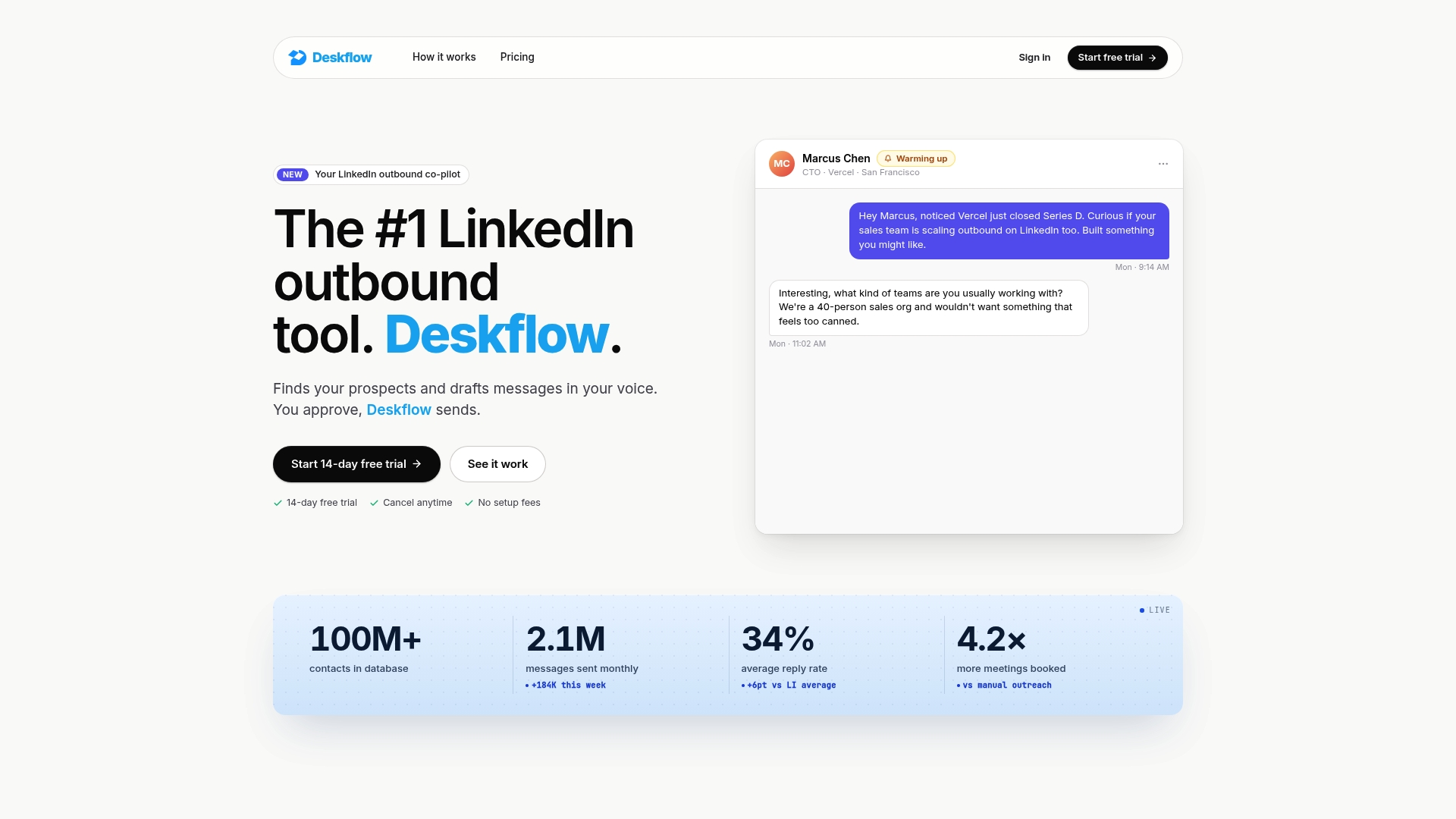
Deskflow is built to handle the heavy lifting. You can import LinkedIn Sales Navigator searches directly into Deskflow, and the platform enriches contact data, generates personalized messages based on each prospect's LinkedIn activity, and automates your follow-up sequences. Everything runs from one place, so your team spends less time on admin and more time in actual conversations. If you're ready to scale your LinkedIn outreach without scaling your headcount, Deskflow is worth a look. You can also explore how to build outbound sales workflows that connect every step from prospecting to close.
FAQ
What is outbound lead generation in simple terms?
Outbound lead generation is when your sales team proactively contacts potential customers before they've shown interest. It includes cold email, LinkedIn outreach, and phone calls targeted at prospects who fit your ideal customer profile.
What are cold leads in outbound sales?
Cold leads are prospects who match your ICP but have had no prior contact with your brand. They require a structured outreach sequence to move from unaware to interested.
How does outbound differ from inbound lead generation?
Outbound means your team initiates contact. Inbound means prospects find you through content or search. Outbound delivers faster results. Inbound builds long-term pipeline at a lower cost per lead over time.
How many touchpoints does outbound lead generation require?
A proven cold outreach sequence uses five touchpoints spread across two to three weeks. Most replies come after the second or third message, not the first.
What metrics should I track for outbound lead generation?
Track reply rate, meeting booked rate, and pipeline contribution per campaign. A reply rate above 5% and a meeting booked rate above 2% are healthy benchmarks for cold email outreach.