
Omnichannel outreach is defined as the coordinated delivery of communications across multiple channels, including email, SMS, social media, voice, and live chat, so every touchpoint shares context and feels like one continuous conversation. Unlike a standard multichannel approach, omnichannel outreach treats your entire channel mix as a single system. Platforms like Salesforce, Adobe Journey Optimizer, and Shopify have built entire product lines around this principle. The result is a customer experience where switching from an email thread to a phone call to a LinkedIn message never feels like starting over.
What is omnichannel outreach, and how does it work?
Omnichannel outreach is the practice of coordinating communications across channels so they share context and feel like one conversation rather than independent campaigns. The key word is "coordinated." A prospect who opens your email on Tuesday and then gets a LinkedIn message on Thursday that references that email is experiencing omnichannel outreach. A prospect who gets the same generic pitch on both channels is experiencing multichannel outreach done poorly.
The mechanics rely on a unified customer profile. Every interaction, whether a clicked link, a replied SMS, or a completed demo call, feeds back into a central record. That record then informs what message goes out next, on which channel, and at what time. Without that feedback loop, you're just broadcasting on multiple frequencies at once.

The industry term for this approach is "omnichannel marketing," and it's the recognized standard in both B2C and B2B contexts. The phrase "omnichannel outreach" is widely used in sales and SDR circles to describe the same principle applied specifically to prospecting and pipeline generation.
How does omnichannel outreach differ from multichannel outreach?
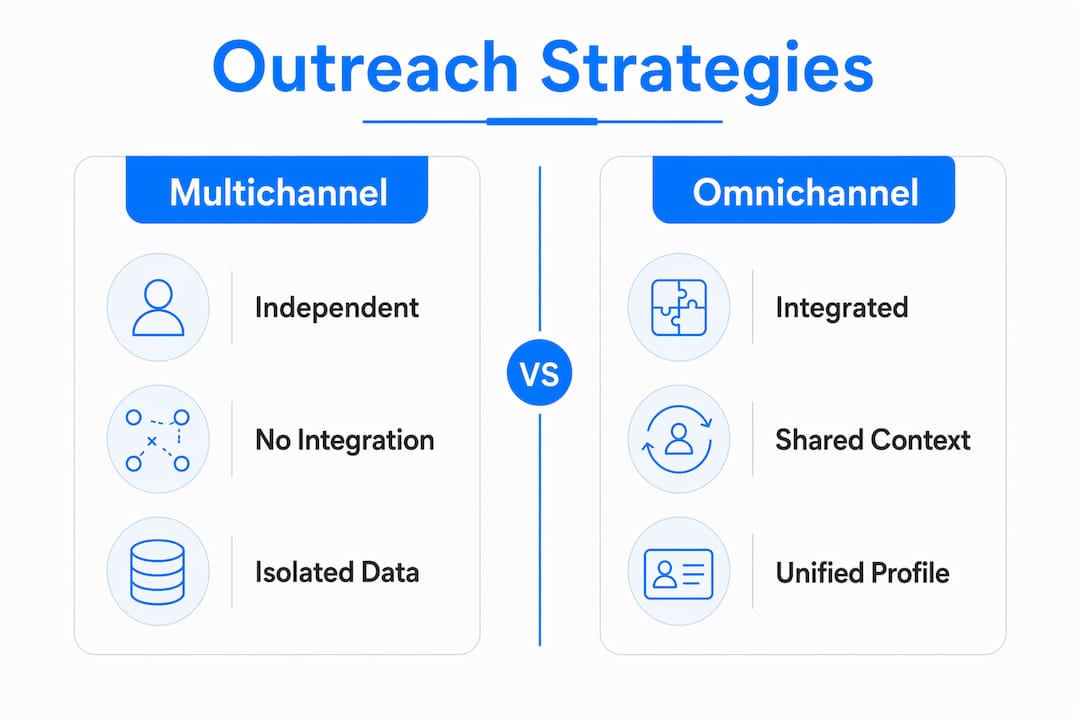
Multichannel outreach means your brand is present on several channels. Omnichannel outreach means those channels integrate and inform each other in near-real-time. That distinction sounds subtle, but the operational gap is enormous.
A multichannel campaign might send a cold email sequence through one tool, run LinkedIn ads through another, and have SDRs making calls from a spreadsheet. None of those systems talk to each other. A prospect who replies to the email still gets the LinkedIn ad. An SDR calls someone who already booked a demo. The experience feels fragmented because it is.
Omnichannel execution solves this by treating channel state as shared data. When a prospect books a demo, every other active touchpoint pauses or updates automatically.
| Feature | Multichannel | Omnichannel |
|---|---|---|
| Channel coordination | Independent | Integrated |
| Customer data | Siloed per channel | Unified profile |
| Context preservation | Starts fresh each time | Carries across channels |
| Messaging consistency | Varies by channel | Consistent and sequential |
| Outcome | Fragmented experience | Coherent conversation |
Pro Tip: Most teams think they're running omnichannel campaigns because they use email, LinkedIn, and phone together. If those tools don't share suppression logic or contact state, you're running three separate multichannel campaigns, not one omnichannel program.
What technologies enable effective omnichannel outreach?
The technology stack behind omnichannel outreach has three core layers: unified customer profiles, real-time data flows, and journey orchestration.
Unified customer profiles are typically built using Customer Data Platforms (CDPs) or identity resolution systems. Shopify describes omnichannel as preserving context through unified profiles that link email, live chat, social, and other channels into one record. Without this layer, every channel sees a different version of the same customer.
Real-time data flows keep that profile current. Near-real-time updates of customer state are what allow a system to know that a prospect just visited your pricing page and trigger the right next message on the right channel. Confluent and similar data infrastructure providers build the pipelines that make this possible.
Journey orchestration platforms sit on top of those data layers and execute the logic. Adobe Journey Optimizer enables drag-and-drop workflow design that delivers messages across channels from unified datasets. It handles sequencing, suppression, and channel selection based on behavior rules you define.
- A CDP or CRM that centralizes contact history across all channels
- Identity resolution to link the same person across email, social, and phone
- A journey orchestration tool to define sequencing and channel logic
- Real-time data pipelines to keep customer state current
- Suppression and deduplication rules to prevent contradictory messages
Pro Tip: Your source of truth for suppression logic is the most underrated part of your stack. Without it, customers receive contradictory messages across channels, and the experience becomes worse than if you had stayed on a single channel.
What are the key benefits of omnichannel outreach?
The business case for omnichannel outreach is well supported by research. A meta-analysis of 63 studies confirms that channel integration quality directly drives patronage intention and customer loyalty. That finding matters because it shifts the conversation from "how many channels should we use" to "how well are our channels connected."
The practical benefits break down into four areas:
- Higher customer satisfaction. Customers don't repeat themselves. Support agents and sales reps have full context before the conversation starts.
- Stronger loyalty. Channel integration quality mediates positive outcomes including repeat purchase and long-term retention.
- Better data. Every interaction enriches the unified profile, giving you sharper segmentation and more accurate attribution.
- Lower operational waste. Integrated systems eliminate duplicate outreach, redundant follow-ups, and the manual work of syncing contact records across tools.
The loyalty finding from that meta-analysis is particularly worth noting. Omnichannel success depends more on integration quality and smooth handoffs between teams than on the number of channels you activate. Adding a fifth channel to a poorly integrated stack makes things worse, not better.
How to implement an effective omnichannel outreach strategy
A practical omnichannel outreach strategy starts small and scales deliberately. Mapping a few high-value customer journeys and defining channel roles per journey stage is the right starting point, not trying to coordinate every channel at once.
-
Map your highest-value journeys first. Pick two or three journeys, such as awareness to demo request, trial to paid conversion, or churn risk to retention. Define what a successful outcome looks like for each.
-
Assign channel roles per stage. Email might own awareness nurture. LinkedIn handles social proof and warm touchpoints. Phone or SMS activates for high-intent signals. Each channel has a job, and the orchestration logic enforces it.
-
Integrate your data sources. Connect your CRM, marketing automation tool, and any outreach platforms so contact state updates in near-real time. This is where most teams underinvest and where most omnichannel programs fail.
-
Set sequencing and suppression rules. Define what triggers the next touchpoint and what stops outreach entirely. A booked meeting should suppress all active sequences. A replied email should pause LinkedIn automation.
-
Build outbound sales workflows that reflect these rules. Document the logic so every SDR and marketer follows the same playbook, not their own version of it.
-
Measure and adjust by journey, not by channel. Track conversion rates and engagement at the journey level. A channel that looks weak in isolation might be doing critical warming work that shows up later in the funnel.
The most common implementation failure is treating omnichannel as a technology project rather than a strategy project. The tools matter, but the channel role definitions and sequencing logic are what actually drive results.
What are common examples of omnichannel outreach in action?
Concrete omnichannel outreach examples make the concept easier to apply. The pattern across all of them is the same: one channel informs the next.
B2B prospecting sequence. A sales rep sends a personalized cold email referencing a prospect's recent LinkedIn post. Two days later, a LinkedIn connection request goes out. If the prospect accepts and visits the company website, an SDR gets an alert to call within the hour. The call references the email and the LinkedIn interaction. That's a coordinated three-channel sequence, not three separate campaigns.
E-commerce retention. A customer abandons a cart. An email goes out within an hour. If it's not opened in 24 hours, an SMS follows. If the customer opens the SMS but doesn't convert, a retargeting ad appears on social. Each channel knows what the others have done.
Customer support handoff. A customer starts a live chat, gets transferred to a phone agent, and the agent already has the full chat history. The customer doesn't repeat a single detail. That's omnichannel communication working at the service layer.
Poor multichannel versus true omnichannel. A prospect gets a cold email, a LinkedIn InMail, and a phone call in the same week, all with different messaging and no awareness of each other. That's multichannel noise. The same three touchpoints, sequenced with shared context and consistent messaging, become an omnichannel conversation.
Pro Tip: The clearest signal that your omnichannel program is working is when prospects reference a previous touchpoint in their reply. "I saw your email and then your LinkedIn message" means the sequence landed as a coherent story, not random outreach. Track that qualitative signal alongside your open and reply rates.
You can also apply email personalization best practices at each stage of the sequence to make every touchpoint feel relevant rather than templated.
Key Takeaways
Omnichannel outreach works because integrated channels sharing a unified customer profile consistently outperform siloed multichannel campaigns on loyalty, satisfaction, and conversion.
| Point | Details |
|---|---|
| Definition clarity | Omnichannel outreach coordinates channels through shared context, not just presence on multiple platforms. |
| Multichannel vs. omnichannel | The difference is integration: omnichannel channels inform each other; multichannel channels operate independently. |
| Technology foundation | CDPs, real-time data pipelines, and journey orchestration tools are the three required layers. |
| Integration quality wins | A meta-analysis of 63 studies confirms channel integration quality drives loyalty more than channel quantity. |
| Start small | Map two or three high-value journeys and define channel roles before scaling to a full omnichannel stack. |
Why most teams get omnichannel wrong before they get it right
The most persistent misconception I see is that omnichannel means being everywhere. Teams add Slack, WhatsApp, TikTok, and direct mail to their mix and call it omnichannel. What they've actually built is a more complicated multichannel problem.
The teams that get it right start with a question: "What does the customer already know when they reach this touchpoint?" That question forces you to think about data flow before you think about channel selection. It also reveals immediately whether your stack actually shares context or just shares a contact list.
AI and automation are changing the execution layer fast. Tools can now select the next best channel dynamically based on real-time behavior signals. But the underlying logic, the channel role definitions, the suppression rules, the journey maps, still has to be designed by a human who understands the customer. Automation executes the strategy. It doesn't replace it.
My honest recommendation: pick one journey, integrate it properly, and measure it for 60 days before expanding. A single well-orchestrated journey will outperform five poorly connected ones every time. The goal isn't omnichannel for its own sake. The goal is a customer experience that feels like one conversation.
— Christian
How Deskflow fits into your omnichannel outreach stack
If LinkedIn is part of your outreach mix, and for most B2B teams it should be, Deskflow handles the prospecting and automation layer so your SDRs spend time on conversations, not admin work.
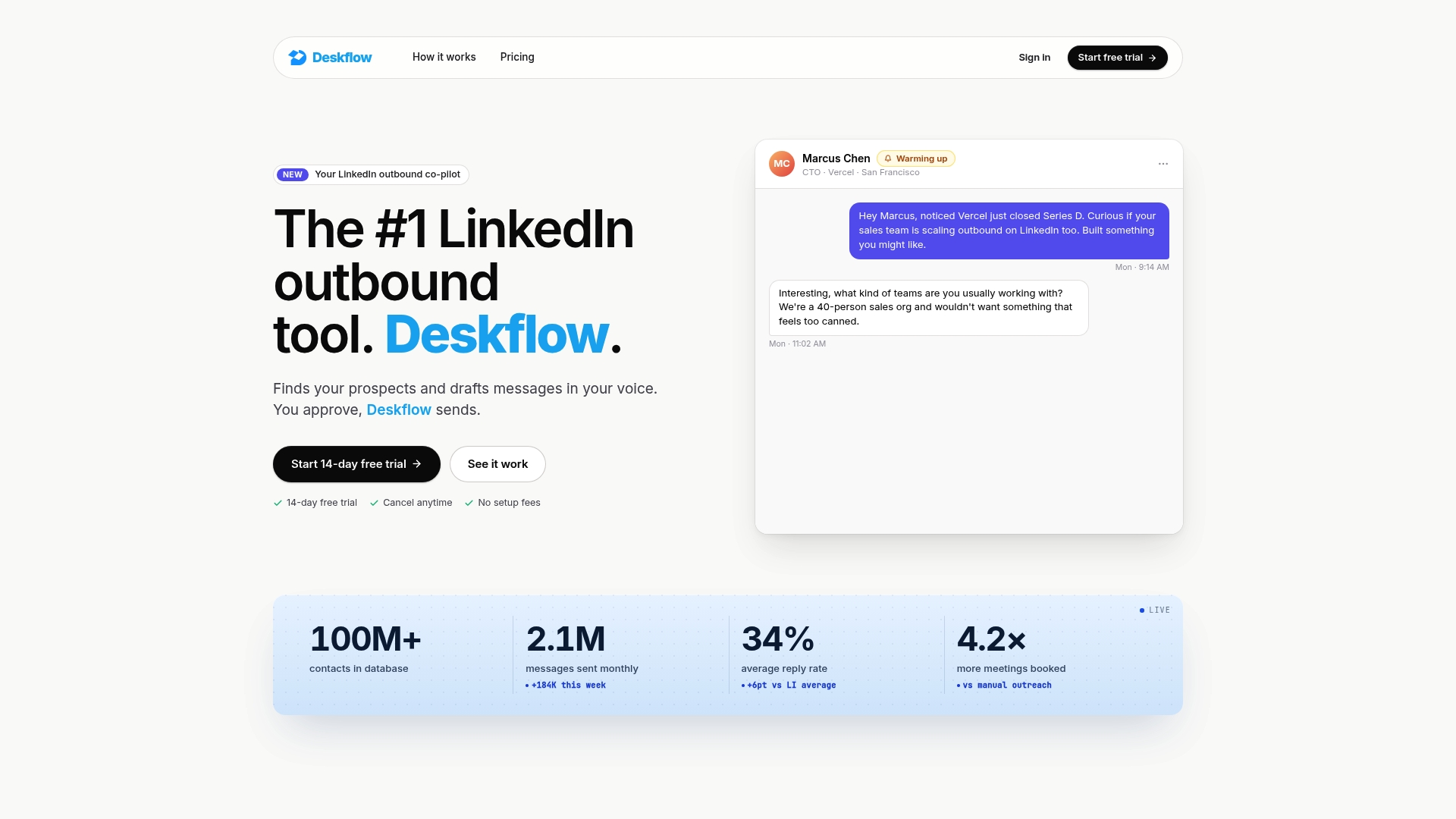
Deskflow connects LinkedIn prospecting directly to your outbound sequences. It finds ideal prospects, enriches contact data, generates personalized messages based on each prospect's LinkedIn profile and activity, and automates follow-up sequences. That means your LinkedIn touchpoints stay coordinated with your email and phone outreach instead of running as a separate silo. If you're building a true omnichannel outreach program, Deskflow on autopilot gives you the LinkedIn layer without the manual overhead.
FAQ
What is the difference between omnichannel and multichannel outreach?
Multichannel outreach uses multiple channels independently, while omnichannel outreach integrates those channels so each touchpoint shares context and informs the next. The core difference is data integration, not channel count.
What channels are included in omnichannel outreach?
Omnichannel outreach typically coordinates email, SMS, social media, voice calls, and live chat. The specific channel mix depends on your audience and journey stage, not on using every channel available.
Why does channel integration quality matter more than channel quantity?
A meta-analysis of 63 studies found that channel integration quality, not the number of channels, drives customer loyalty and patronage intention. Adding more channels to a poorly integrated stack reduces experience quality.
What technology do you need for omnichannel outreach?
You need three layers: a unified customer profile (from a CDP or CRM), real-time data pipelines to keep that profile current, and a journey orchestration platform to execute sequencing and suppression logic across channels.
How do you measure omnichannel outreach success?
Measure at the journey level, not the channel level. Track conversion rates, reply rates, and customer satisfaction scores across the full sequence. A channel that looks weak in isolation may be doing critical work earlier in the funnel.